- Error
Sri Lanka High Commission in Ottawa
APPOINTMENT OF THE HIGH COMMISSIONER OF THE REPUBLIC OF SOUTH AFRICA TO SRI LANKA
Tuesday, 16 November 2021 20:15
The Government of the Republic of South Africa with the concurrence of the Government of Sri Lanka has appointed Mr. Sandile Edwin Schalk as the High Commissioner of the Republic of South Africa to Sri Lanka in Succession of H.E. (Ms.) Robina P. Marks. He has presented credentials to H.E. Gotabaya Rajapaksa, President of Sri Lanka on 16 November 2021 at 10.30 a.m. at President’s House, Colombo 01.
Foreign Ministry
Colombo
16 November, 2021
APPOINTMENT OF AMBASSADOR OF JAPAN TO SRI LANKA
Tuesday, 16 November 2021 20:14
The Government of Japan with the concurrence of the Government of Sri Lanka has appointed Mr. Hideaki Mizukoshi as the Ambassador Extraordinary and Plenipotentiary of Japan to Sri Lanka in Succession of H.E. Akira Sugiyama. He has presented credentials to H.E. Gotabaya Rajapaksa, President of Sri Lanka on 16 November 2021 at 10.30 a.m. at President’s House, Colombo 01.
Foreign Ministry
Colombo
16 November, 2021
FOREIGN MINISTER PEIRIS MEETS FOREIGN MINISTER OF BANGLADESH
Tuesday, 16 November 2021 13:46
Foreign Minister Prof. G.L. Peiris today (15/11) met the Foreign Minister of Bangladesh Dr. A.K. Abdul Momen at the State Guest House Padma in Dhaka.
Foreign Minister Peiris recalled the visit of Prime Minister Mahinda Rajapaksa who visited Bangladesh in March 2021 for the joint celebration of the 100 Birth Anniversary of Bangabandhu and the Golden Jubilee of the Independence Celebration of Bangladesh and that the discussions were very fruitful and the Prime Minister appreciated all aspects of his visit.
The Foreign Minister expressed warm appreciation for the consistent support which Sri Lanka received from Bangladesh in international fora especially the Human Rights Council and the CMAG (Commonwealth Ministerial Action Group) of which the previous Foreign Minister who is the current Education Minister of Bangladesh was the Chair.
The two Ministers also discussed the active commercial relationship between the two countries with Sri Lankan investment into Bangladesh being in the region of approximately 2.5bn USD. About 110 Sri Lankan companies are operating here and are excelling especially in the services sector such as insurance, banking and power sectors. However, there is scope for improvement of the volume of trade which is presently at the level of 200 mn USD annually.
Sri Lanka is keen on a Preferential Trading Agreement with Bangladesh and is happy that Technical negotiations have commenced and are proceeding.
There is particular interest in cooperation in the field of shipping because of Sri Lanka’s focus as a shipping hub and would like to strengthen the cooperation between the ports of Chittagong in Bangladesh and the ports of Colombo and Hambantota.
Emphasis was made in particular on the feeder services and coastal shipping arrangements. Cooperation between Bangladesh and Sri Lanka regarding a transshipment hub would be beneficial to Bangladesh because of the reduction of time and nautical miles.
The Foreign Minister said that a substantial number of Sri Lankan students are receiving their education in Bangladesh with Chittagong being popular among medical students.
Sri Lanka has reciprocally offered to assist with the training of nurses of Bangladesh in educational institutions in our country.
In regard to tourism, direct connectivity between Colombo and Dhaka is helpful and the Bangladesh Minister intimated the interest of a private Bangladesh airline in operating flights to Colombo.
The two Ministers discussed in detail cooperation between the two countries, within the framework of the IORA with particular reference to conservation of marine resources and security dimensions.
Foreign Ministry
Colombo
15 November, 2021
FOREIGN MINISTER G.L. PEIRIS TO ATTEND 21ST MEETING OF IORA COUNCIL OF MINISTERS IN DHAKA
Tuesday, 16 November 2021 13:44
Foreign Minister Professor G. L. Peris will undertake an official visit to Dhaka, Bangladesh from 15 to 18 November, 2021.
The Minister will attend the 21st Meeting of the Council of Ministers (COM) of the Indian Ocean Rim Association (IORA) where Sri Lanka will take over the Vice Chair position of IORA for the period 2021 to 2023. The Council of Ministers meeting will be preceded by the meeting of the Committee of Senior Officials (CSO).
On the sidelines, Minister Peiris is expected to have discussions on matters of bilateral importance to both countries.
Foreign Ministry
Colombo
14 November, 2021
SRI LANKA BRINGS THE IMPORTANCE OF SUSTAINABLE NITROGEN MANAGEMENT TO THE CLIMATE CHANGE DISCOURSE
Friday, 12 November 2021 17:51
The Foreign Ministry of Sri Lanka organized an event ‘Rediscovering Nitrogen: Solution synergies for climate change, health, biodiversity and circular economy’ together with the International Nitrogen Management System (INMS), focused on the nexus between climate and nitrogen waste, ahead of COP-26, on the evening of 31 October 2021 in Glasgow. The phrase ‘Rediscovering Nitrogen’ is used as Nitrogen was discovered in 1772 by scientist Daniel Rutherford in Scotland. The event discussed how action on nitrogen is a necessary next step to help meet climate goals with multiple co-benefits for the environment, health and the economy.
High-level statements from the President of Sri Lanka, UK Government, UNEP, the Commonwealth, Director General of the South Asia Cooperative Environment Programme (SACEP) and others discussed options for action ahead of COP-26. The event launched the #Nitrogen4NetZero proposal for COP-26, brought forward by SACEP reflecting work with its member countries.
It further focused on Sri Lanka’s progressive climate ambitions as depicted through its updated and ambitious NDCs already submitted to the UNFCCC mechanism, including Sri Lanka’s road map for de-carbonization by 2050, achieving 70% renewable energy target by 2030, a landmark decision on no new coal plants and pioneering work on mangrove restoration and conservation. The opportunities for FDI, particularly for green industries and tourism on the country’s journey towards implementing the NDCs was also shared at this event.
The event was chaired by Chief Scientific Advisor for Scotland and Scientific Director of Moredun Research Institute Prof. Julie Fitzpatrick. The Minister of Environment Mahinda Amaraweera delivered the welcome address, followed by introductory remarks by Professor Mark Sutton. Professor Sutton stressed on the importance of halving nitrogen waste under the Colombo Declaration, which would save us an amount of 100 billion USD per annum.
The Keynote address was delivered by President Gotabaya Rajapaksa, who emphasized that “The challenge facing us now is to use modern scientific techniques and practices to enhance agricultural production without causing environmental degradation. We require a new agricultural revolution that has sustainability at its core.” President further stated that “…Sri Lanka especially welcomes investments into renewable energy as well as organic agriculture and is prepared to support their success through incentives and appropriate policy interventions. I therefore hope that greater cooperation in this regard will be forthcoming in the future.”
Unfortunately, Minister for South Asia, the United Nations and the Commonwealth at the Foreign, Commonwealth & Development Office (FCDO) UK Lord Ahmad of Wimbledon was unable to attend the event, due to a train accident that occurred on the 31 October 2021. His speech was delivered by UK’s Regional COP-26 Ambassador for Asia Pacific Ambassador Ken O’Flaherty. Delivering the speech on behalf of Lord Ahmad, Ambassador O’Flaherty reiterated the importance of raising awareness of the impact that nitrogen pollution has on the climate, the environment, and our health. He further elaborated on"The need for global action, to protect our planet for future generation has never been so urgent and the UK has played a leading role among developed countries in cutting carbon emissions”. The UK’s stride to legislate for net zero emissions by 2050 was highlighted in his speech, as UK was the first major economy to do so and to set in law the world’s most ambitious climate change target, cutting emissions by 78% by 2035.
Key speakers at the event were, Under Secretary to the United Nations and Executive Director of the United Nations Environment Programme Inger Anderson, via video, Director General of the South Asian Cooperative Environment Programme (SACEP) Dr. Masumur Rahman and State Secretary, Federal Ministry of Environment of Germany Jochen Flachsbarth also through a video message.
Urmi Goswami of the Economic Times of India and Professor Sutton had a two-way conversation titled “Why Nitrogen?” as part of the programme for the evening. The discussion emphasized the direct Global Warming Potential (mass basis) of GHG Nitrous Oxide (N2O) which is 296 times greater than Carbon Dioxide (CO2), during a time period of 100 years. The reduction of Nitrous Oxide emissions will be essential if the world is to achieve net zero GHG emissions.
Among other prominent attendees were the President of Maldives Ibrahim Mohamed Solih and Secretary of Foreign Affairs of the Republic of Philippines Teodoro Jr. Locsin. Over 90 attendees representing national delegations, the British Government, private sector personnel from the business and finance industry and academics were present.
The Baroness Scotland of Asthal, Secretary General of the Commonwealth, the Rt. Patricia Scotland reminded the audience that “…Sri Lanka has been on this journey with the Commonwealth with fifty-four countries representing 2.5 billion people…”. She added further that “If you regrettably go back, and look at that declaration, all the worries of this being an existential threat was there and Sri Lanka was leading then, and Sri Lanka is still leading now.” She commended both the President of Sri Lanka and the President of Maldives for having shown that they are not interested in just talking but that they are totally committed to doing. She went on to assure that the Commonwealth Secretariat’s support in the implementation process and developing an implementation tool-kit. She emphasized the pertinent need to understand the connections between mangroves and nitrogen and welcomed Sri Lanka to join forces again with the Commonwealth Secretariat in developing appropriate mechanisms.
Secretary to the Ministry of Environment Dr. Anil Jasinghe announced “…that the Government of Sri Lanka submitted a fresh value-added Resolution on Sustainable Nitrogen Management on the 26 October, proposing more comprehensive actions beyond the UNEA 4/14 Resolution of 2019.” He further added that as the year 2030 is fast approaching, Sri Lanka introduced several new elements in the proposed resolution, as highlighted in the Colombo Declaration. This new resolution will lay the foundation for action on nitrogen for climate coordinating all related Multilateral Environment Agreements via the Inter-convention Nitrogen Coordination Mechanism.
Delivering concluding remarks, Foreign Minister Prof. G. L. Peiris emphasized that Sri Lanka is ideally equipped to play a pioneering role in global initiatives with regard to climate change and biodiversity. He stated that "… we in Sri Lanka have never believed for one moment, that there is any conflict between economic development on the one hand and the preservation of the environment on the other. these two aspects go together. They are complimentary, they are two sides of the same coin.” He reiterated that the President Gotabaya Rajapaksa made a bold decision to move from chemical fertilizer to organic fertilizer, which is having a profound impact on all agricultural activity in Sri Lanka. The shift would entail in less pollution of water and soil and thereby polluting the oceans less, with an overall positive impact on the health of the population of the country.
Referring to the comments of Baroness Patricia Scotland, conveying the critical message of implementation as opposed to aspiration, Professor Peiris went on to state that “…This is because we do not have the luxury of time. Lofty aspirations and plans for the future are not sufficient. What is urgently required is immediate implementation. The Foreign Minister assured the audience that Sri Lanka is far from being politically indifferent, and that ours is an attitude of intense commitment and rigorous involvement. He assured the international community that Sri Lanka will always be a resolute and steadfast partner in all efforts directed towards the preservation of the environment and much more, for the very survival of this planet for the benefit of generations to come.
Foreign Ministry
Colombo
12 November, 2021
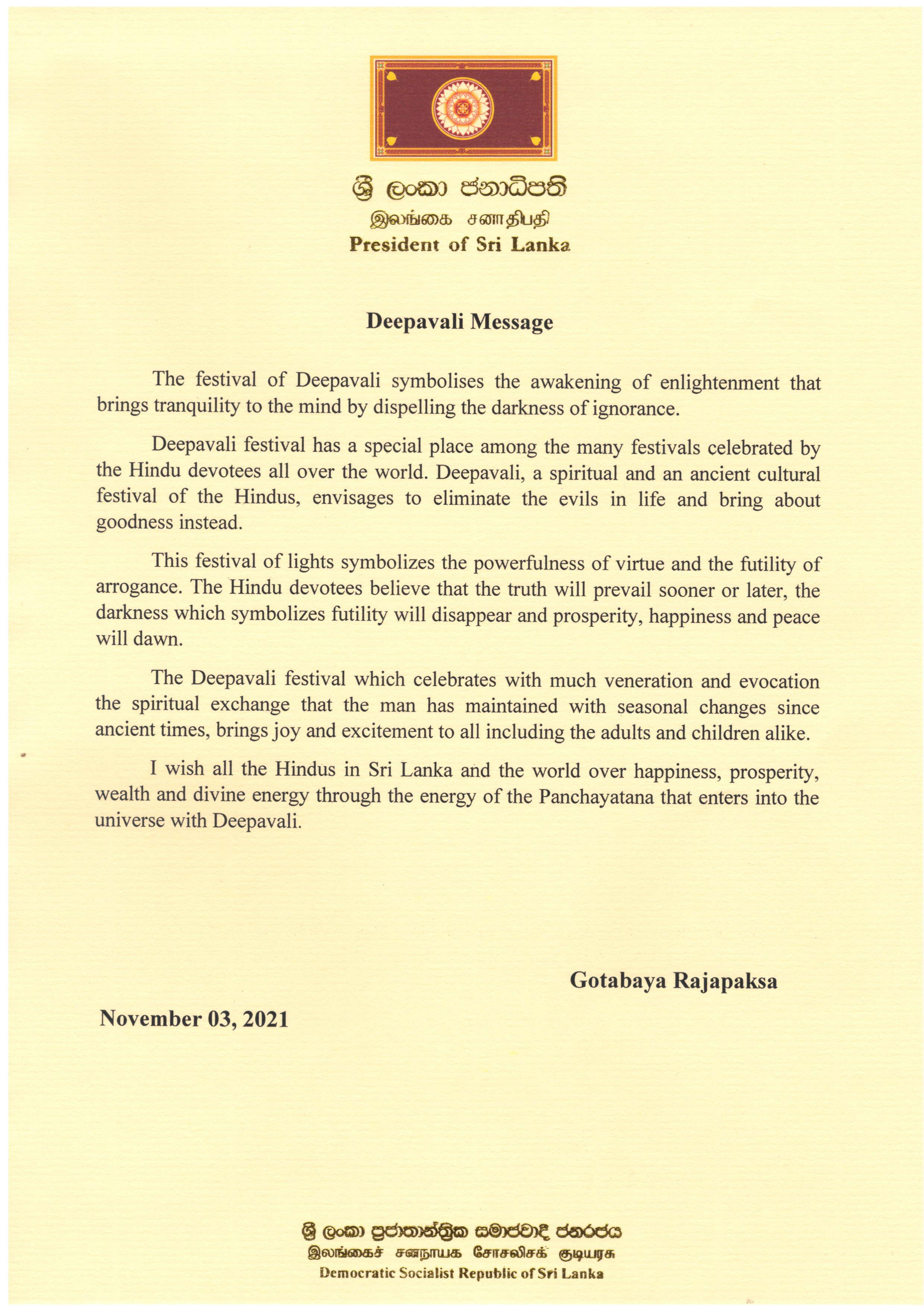
Deepavali Message of H.E. the President
Wednesday, 03 November 2021 18:47
SPEECH BY PRESIDENT GOTABAYA RAJAPAKSA AT THE “ WORLD LEADERS SUMMIT OF COP26", UN CLIMATE CHANGE CONFERENCE, SCOTLAND, UK | 01 NOVEMBER 2021
Tuesday, 02 November 2021 13:50
Chairperson
Excellencies
Delegates.
This event takes place at a critical time for humanity.
As a developing tropical island nation with abundant biodiversity, Sri Lanka is deeply aware of the impacts of climate change.
Our rich philosophical heritage, shaped by Lord Buddha’s teachings, places great value on environmental integrity.
Sustainability is therefore at the heart of our national policy framework.
Sri Lanka’s updated Nationally Determined Contributions aims to reduce emissions towards achieving carbon neutrality by 2050.
We have prioritised enhancing national forest cover, with initiatives underway to increase our carbon sequestration capacity by 7% by 2030.
We will increase contribution of renewable energy sources to 70% of national energy needs by 2030 and are taking steps to phase out use of fossil fuels.
Sri Lanka is also proud to be a co-lead of the “Global Energy Compact for No New Coal Power”.
Sri Lanka recently restricted imports of chemical fertilizers, pesticides, and weedicides due to public health concerns, water contamination, soil degradation, and biodiversity impacts.
Although opposed by entrenched lobbies, this has created opportunities for innovation and investment into organic agriculture that will be healthier and more sustainable in future.
Reactive nitrogen emissions from overuse of artificial fertilizer is a major contributor to climate change.
In 2019 Sri Lanka spearheaded the Colombo Declaration on Sustainable Nitrogen Management, which seeks to halve Nitrogen waste by 2030.
We look forward to more countries joining this initiative.
Sri Lanka also leads the Action Group on Mangrove Ecosystems and Livelihoods under the Commonwealth Blue Charter initiative.
Sri Lanka welcomes investments, technology transfers, and climate financing for its ambitious sustainability efforts, along with broader development assistance to support recovery from the COVID19 pandemic.
Climate change affects all nations, but disproportionately impacts developing island nations.
Developing nations that take bold steps towards climate change mitigation and adaptation deserve extensive support.
It is essential that the world’s largest emitters of greenhouse gases fulfil their national commitments and assist developing nations navigate through the climate crisis.
I call upon all nations to work together in a spirit of true cooperation to overcome this crisis and sustain humanity and our planet.
Thank you.
...........................................
The video can be viewed through the following link: https://youtu.be/
Page 29 of 167